For business owners in the competitive outdoor living sector, the fastest route to growth often hinges on a single, critical decision: manufacturing strategy. When the goal is to expand your catalog and increase margins, you are generally faced with two primary paths: private label (ODM) and custom manufacturing (OEM).
Both paths lead to having products to sell, but the journeys—and the required resources—are vastly different. Choosing the wrong one can tie up capital for years or leave you with a generic product that fails to gain traction.
Here is an in-depth look at both strategies to help you determine the right fit for your business stage.
1. Private Label (ODM): Speed and Efficiency
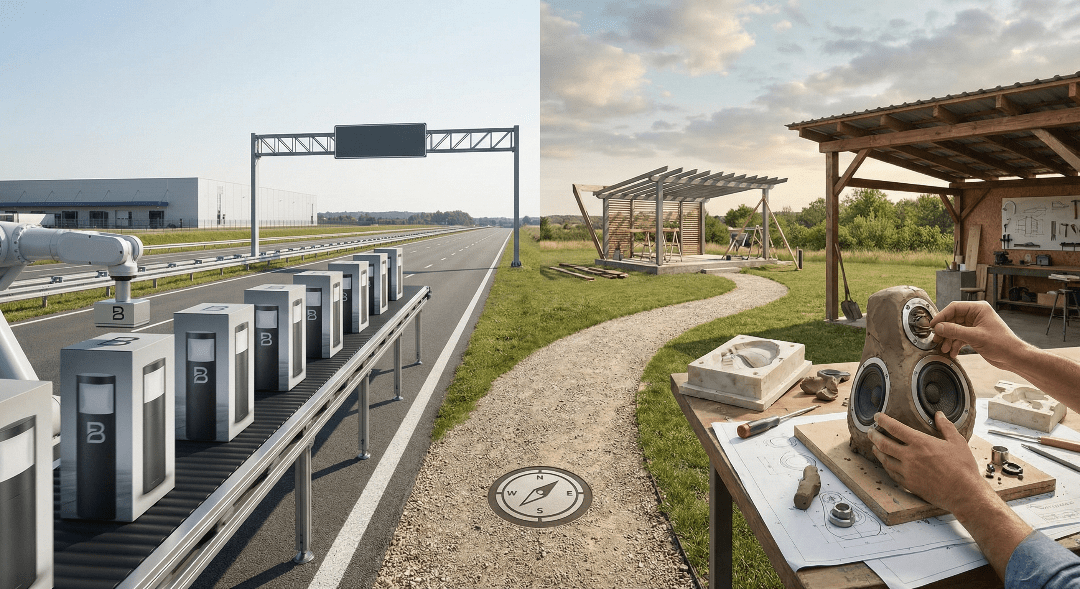
Private Labeling (or Original Design Manufacturing – ODM) involves selecting pre-engineered, factory-ready products from our existing catalog and applying your unique branding and packaging. This is the “off-the-shelf” approach, but don’t mistake it for low quality. These are proven designs already being manufactured at scale.
The Advantages:
- Rapid Speed to Market: Because the R&D, tooling, and testing are already complete, you can go from selection to shipping in as little as 60-90 days.
- Lower Capital Exposure: You avoid expensive mold fees and engineering costs. Your primary investment is inventory.
- Lower MOQs: Since the factory is already producing these units, minimum order quantities are often more flexible than custom runs.
Best For: Brands looking to quickly fill gaps in their catalog. For example, a hardscape distributor who wants to add a reliable line of low-voltage path lights to capture add-on sales without inventing a new fixture.
2. Custom Manufacturing (OEM): Total Control and Differentiation
Original Equipment Manufacturing (OEM) is the process of engineering a product from the ground up based on your specific requirements. You own the Intellectual Property (IP), the molds, and the unique design features.
The Advantages:
- True Differentiation: You get a product that competitors cannot simply order from the same factory. It is uniquely yours.
- Feature Integration: You can solve specific market problems. Need a landscape speaker with a specific mounting bracket for a certain type of decking? OEM is how you get it.
- Margin Protection: Unique products are harder to price-shop, allowing you to maintain higher margins than generic alternatives.
The Reality Check (Hidden Costs): OEM requires patience and capital. You must budget for engineering hours, 3D prototyping, tooling/mold costs (which can range from $5k to $50k+ depending on complexity), and a longer testing phase. The timeline from concept to first shipment is typically 6–12 months.
The Strategic Hybrid Approach
At Global Outdoor Living, we rarely advise clients to choose just one path forever. We often recommend a hybrid strategy for sustained growth.
The Playbook:
- Phase 1 (Cash Flow): Launch quickly with our proven Private Label core products (e.g., standard path lights and spotlights) to start generating revenue and building client trust.
- Phase 2 (Brand Equity): Reinvest profits from Phase 1 to develop a custom OEM flagship product that defines your brand (e.g., a patented, unique brass wash light).
Ready to define your strategy? We have the engineering team for complex OEM and the catalog depth for rapid ODM launches. Let’s discuss your 12-month roadmap.